Showing posts with label class. Show all posts

Thursday, November 28, 2013

Pizza & Momos

This is it. I'm done teaching at Tibet Charity. Final exams were held yesterday; most of my students passed (a few of them have the extra credit to thank for that) and some did exceptionally well. 

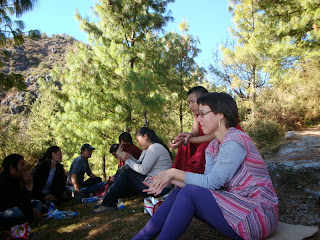
Today Gusti and I took them out for a pizza party in Dharamkot. The students brought some momos, we ordered ten delicious pizzas, and everyone had a lot of fun.


They kept telling me to sit down and relax, but I can't help it -- I enjoy entertaining and if I'm in anything resembling a hostess position, I tend to get into it. I asked them if they have winter holidays coming up in Tibetan/Bhutanese culture aside from New Year's. They said no, but asked about what we've got in the US. I told them all about Thanksgiving (Happy T-day to my friends in the States!), which most of them seemed quite interested in, and they asked all kinds of questions about turkeys. I don't think they have them here. I told them how most Americans prepare a big meal for this holiday so the fact that we were all out having food together was, in a way, quite similar. It's like they'd gotten together to make a Thanksgiving-away-from-home for me, and they seemed pleased that they could do this.

They insisted on doing everything. The students wouldn't let Gusti or me cut the pizzas, they wouldn't let us serve the food, and they always gave us the first slices when a fresh one would come out. Tibetans can be very bossy, but when it's in the context of such hospitality, how can you get upset?

After finishing our lunch and taking a bunch of photos on a dozen different cameras, phones, and tablets, they instructed us to follow them "up to the mountain." When I asked how far they answered "not far," but pointed to some indefinite area wayyyyyyyy off in the distance. I joked that it would take so long I'd miss my flight home. I hadn't worn the proper shoes for a real hike; I knew we'd be taking pictures so I opted to wear my red jutis that I got in Jaipur. People have been telling me they're more like house shoes. This bothered me at first, but then I remembered: I don't wear shoes in the house. If they're shoes, and I'm wearing them, it's going to be outside.

I pointed this out to them, that I wasn't wearing anything that could possibly pass for hiking shoes. Jampel, the one monk, told me "the Bhutan guys are very strong, they'll carry you!" to which the "Bhutan guys" responded that Tibetans were stronger (it's true, they tend to be tall and tough in general), but one way or another they'd get me where we were going.

This is Dolker. She's super sweet, and a pretty good student, too.
The view just never gets old.

Eventually we came to a Hindu shrine where we took some more photos and then backtracked just a little to a grassy spot where we could chill, sing songs, and munch on snacks for a while.


When we finally headed back down to McLeod Ganj, they insisted on taking a shortcut -- the same shortcut that Kalden, Brij, Marie, and I took when we went up to Triund that one time. At one point my foot slipped a bit and I heard a chorus of "Ohhh!" from the students who were in the lead and down below us. Lobsang Dolma, one of my quietest but most thorough students, insisted on holding my hand the rest of the way to make sure I didn't fall, even though she had also earlier insisted on carrying my bag as well as Gusti's, even though she already had her own. "Tibetans are very strong," I observed. They asked me if the roads were "like this" where I live; I told them no, only in the forests in some places. Generally they are in much better condition. They seemed to take this as a perfectly good explanation as to why they could navigate the rocky, irregular path so much more easily than us westerners.

Regardless, we made it down with no casualties. What we had originally planned to be a 3-hour event turned into one that lasted all morning and into the afternoon. It was fantastic. I love the comfort level that you reach with people after seeing them nearly every day for weeks or months, and when the official business or class or whatever is done, everyone can just relax and have a good time together. This evening we had our last staff/volunteer dinner at TC, tomorrow morning we have our closing ceremony for the semester, for which I still have to put together a speech of some sort, and after that.... we're all done. I just have to tie up my loose ends around town as far as last-minute gift obtainment, pay my bill at the hotel, eat at my favorite restaurants once or twice more, pack up all of my stuff -- and decide what's not coming back with me -- and that's it. Get on a night bus to Delhi next Tuesday or Wednesday evening, make sure I tell my students ahead of time because I know at least a couple will want to see me off, and go. Exactly one week from this very moment I'll be somewhere in Indira Gandhi International Airport, maybe waiting to go through security, maybe chilling at my gate with a book, but I'll be having my final few hours in India. 

Four months sure flies when you're having fun. I knew it would.

Where should I go for my next trip? I've got a couple of places in mind, but I'm interested to see what kind of input I can get from my dear readers......

Monday, November 18, 2013

Back to Class

While I was in Rajasthan, Gusti and my class managed to get through two chapters in the textbook. They  had a test scheduled for today -- I try not to have them fall on Mondays, but we're in crunch time now so I just went with it; plus I haven't been here to object -- so I figured it would make for a nice, easy segue back into teaching mode.

When a few of my students saw me in the hall before class I got surprised looks and excited hellos. It was like they didn't expect me to actually come back after my trip! I suppose, to be fair, I had told them I'd be gone "2 or 3 weeks," and at the time I had been leaning more toward 2, so maybe it's not unreasonable that they thought I just decided to stay.

They were curious about my trip so I told them briefly about some of the highlights: riding camels in the desert, the broken train on the way back... but some of them tend to make use of the full 2 hours allowed on test day, so I didn't want to cut into that too much.

They seemed to struggle with the test. Even my strongest students regarded their papers with furrowed brows and made extra use of their erasers. Everyone took longer than usual to finish. I had to clarify a bunch of points, and even then they seemed to have trouble.

They all finished, though, and on time.

I just finished grading the stack of exams, and oh my goodness... they aren't looking very good. I'm not sure what happened, but they definitely weren't lying when a bunch of them told me as they turned in their papers that the test was "very difficult." I wound up giving everyone an extra 10 percentage points so their final grades wouldn't be too thrown out of whack; we won't have time to re-take them, and since I wasn't here to make sure they understood the material, I can't say for sure what happened. When everyone in a class fails to understand, though, I don't think you ought to punish the students because clearly something else is up. Maybe the material was too difficult, maybe they rushed through it... I'm not sure, but it's my opinion that a student's understanding of the material is far more important than a grade, and if they can communicate effectively in English then I see no reason to bum them out with poor marks when it's probably not their fault anyway.

It's for this same reason that I'm with Van on the subject of recognizing the top 2-3 students in each class at our closing ceremony (we're against it): it doesn't matter if you get better scores than your peers, what matters is being able to use the language.

Anyway, I'm glad that's over. I think we may spend most of class tomorrow going over the test and trying to understand what the heck happened.

On a completely unrelated note, the areas around my hometown got hammered by tornadoes yesterday. It's my understanding that most of the damage was to property; relatively few people were injured. I wish I were there to help out. :( This is the first time I really felt the distance from home: there's insanity happening near a great many of the people I care about, and there's not a damned thing I can do aside from follow it online. A friend sent me this message (I hope you don't mind me reposting it, you-know-who-you-are):

You travel across the world to help refugees and thus inadvertently escape the apocalypse back home. I don't believe in karma or anything, but yeah. Karma.

Huh. I hadn't even thought of it like that.

Thursday, October 17, 2013

The way I tend to be

Last night as I made my way up the steps of Pause Dwelling, I heard a familiar "namaste, ma'am" from just above and to my left. It was promptly followed by a short string of Hindi, of which I was able to make out just enough to stumble through a response of "I'm going to my room" (मै मेरा कमरा जा रहीं हूँ ). ... Or at least that's what I said, it might not quite be right.

He said something else so I hopped up the last couple of steps and around onto the balcony where he was sitting, and I took the empty seat next to him. Long story short, by the time I actually made it to my room I had a basic understanding of how to write Hindi -- not just try to mimic the typewritten text in books -- and I had also been assigned homework:
Who gives "Don't put off until tomorrow what you can do today" as a first translation assignment??
I also installed a Hindi keyboard and a flashcard app on my phone so I can study when I don't have internet. Brij gave me a couple of movies in Hindi to watch, as well as some music. The language itself really is, I think, relatively easy... it's just the fact that I'm learning a new language at all that's tricky. The grammar seems to be pretty consistent and now that I can read the script, I'm finding that most words are phonetic.

As far as English class at Tibet Charity, today we were studying possessive pronouns and rhyming words. Naturally, the book suggested I give them songs as examples. The ones it provided were Roy Orbison's Pretty Woman and Every Breath You Take by The Police (Every breath you take/Every move you make... boom, rhyming words). I took the liberty of adding my own personal touch and gave them "I was her love, she was my queen/And now a thousand years between" and "Then I remember you/And the way you shine like truth in all you do"... I couldn't help myself. Hearing them read the lyrics off the board was a trip, too.

At the break, Gusti suggested I give them some nursery rhymes to further illustrate the point. Neither of us could recall much, but I did give them "Baa Baa Black Sheep" and "Twinkle Twinkle, Little Star." They really seemed to enjoy it, and they understood rhyming well enough by the end of it that I was able to leave "sky" blank and they figured it out (rhymes with high, judging from the meaning, etc).

Then the book had an activity for us that involved filling in missing words from song lyrics. The song it chose, due to its high content of possessive pronouns, was this. I felt like I was either at a wedding reception or a high school dance. Imagine me teaching this to a bunch of monks and nuns. Pretty hilarious, right? Now I've got it stuck in my head.

So it goes. There are worse things in the world.


Wednesday, October 16, 2013

Truly affordable healthcare

I took my first of the "precious pills" from the Tibetan Men-Tsee-Khang this morning. I even woke up, took it with warm water, and went back to sleep under some blankets, just like the instructions said! As luck would have it, I also managed to avoid eating putrid food, getting into an accident, and having sex. So far so good!

After some thought I decided that I'd be missing out if I spent four months here, in the center of the Tibetan nation-in-exile, and didn't actually go check out the Tibetan medical facilities. Everyone keeps telling me about how you go in there and they diagnose you based on what your pulse feels like.

I'm intrigued. The 40 rupee price tag makes it even more appealing.

So today after class I went to check it out. I was told to take a number and have a seat by room C3.


After a wait of maybe fifteen minutes (and a line-jumping old Tibetan man), it was my turn. I went in to see doctor, a youngish Tibetan man of maybe 40, who was very kind and soft-spoken. He asked me a few questions, took my pulse in both wrists, and told me he'd write me a script for a couple of different medicines. I have some that I am supposed to take before breakfast, after lunch, and before bed, and then a different one that I take once a week. He also instructed me to "not take too many sweets" and to keep warm, especially on my lower back, and especially in the evenings. 

That sounds easy enough, right? 

After I paid (a whopping 550 rupees for a month's supply of these 4 different medicines, plus the office visit... I might have to move here just for the healthcare) I went over to the "medicine counter" where the women behind the glass read the doctor's order and filled little bags from jars of what looked like malted milk balls.
It's worth a shot, I suppose.


Yesterday in class the book had us practicing the form "What do you think of                 ?" "I like (him/her/it)." In order to do this, we were asked to make lists of famous people. It wanted four each of famous actors, famous actresses, pop groups, and TV "programmes." I had a feeling this was an exercise in futility, so I told my students to change it to famous men, famous women, musicians, and we did leave the TV programs as it was.

Here's the list we came up with:
Gotta love that Tibetan worldview.

Oh, and I also just discovered Memrise. It's like DuoLingo but with about a zillion more lessons. The only potential drawback I can see so far is that the lessons are submitted by users, so I'm not sure how accurate or regulated they are -- it's kind of like a cross between DuoLingo and Coursera. Regardless, DuoLingo does not yet have a Hindi program, so I'm taking my chances here. I also installed the Hindi keyboard so I can accurately type all the new words; it's taking some getting used to.

Wednesday, October 9, 2013

Make the vowel say its name

One thing I realized earlier is that some of the best classes we have at Tibet Charity are the ones that are not done, literally, by the book. My favorite ones to teach and, it seems, the ones that are often the favorites of the students as well, are the ones where we get off on some kind of tangent and explore some aspect of English that isn't necessarily in the lesson plan. A while back there was an entire day where all we did was prefixes, suffixes, and root words.

Today we wound up spending some time on pronunciation and spelling; the students had taken a test yesterday and I always go over it with them as a class the next day. Only one or two of them had spelled “twentieth” correctly, and when we read the reading passage I decided we could use some pronunciation practice. The main topic was how when a word ends in the letter “e,” the preceding vowel “says its name.” Obviously, like all rules in English, this is not an absolute... but it helped them distinguish between “Tim” and “time,” and I wound up teaching them a bunch of new vocabulary words in the process of illustrating the rule. We used words like pal/pale, tam/tame, slid/slide, and can/cane. They learned not only how to pronounce “crate” and “kale” but what they mean.

After that we did some sentence correcting on the board, which always goes over well. The first time I had them do it they were quite shy, but now that it's become a semi-regular thing they seem to enjoy it. I take sentences from their writing assignments and change some of the details but keep the mistakes. They go back and forth and help each other figure out how to fix them. I should probably spend more time developing exercises to supplement this, but we're not supposed to make copies aside from tests... so it's a little tricky. At least we have fun. Fun things are easier to remember.

This afternoon we said farewell to a couple of the teachers; Brij and Marie left on a trip to Rishikesh, where they will stay for at least the next week. As far as I know they don't have a strict itinerary, which is the same way we plan to see Rajasthan later this month. Everybody wish them a safe and fun trip!

While the two of them were getting their things to the bus to Rishikesh, I accompanied Verity, Gill, and Gusti to a meditation group that is held on Wednesday evenings here. They went once a couple of weeks ago; I had never been.

I think it was good for me. I'm going to try to work in a bit of meditation on a regular schedule and see what happens. I try to apply a lot of the principles that were introduced tonight anyway, but it's definitely something that could afford to be practiced and cultivated.

We did three separate meditations, the second of which was “walking” or “moving meditation.” It was a bit awkward at first, and then I realized that it was because dance is my moving meditation. When I'm home alone I put on music and just move, whatever seems like a good idea, I let the music guide me. That's what they were going for this evening, I think, but seeing as most people are too shy to really let loose in a room of people they don't know (I know I was the first few times I was asked to do it), just walking while drawing your awareness to everything you sense was probably the better way to go. Personally, though, I felt somewhat restricted. I decided I'll have to dance more in my room or maybe up on the balcony when nobody else is around.

I've been trying to work in a bit of yoga here and there, but it's mainly driven by my need to stretch. About a month and a half ago I took a yoga class in Bhagsu where we were instructed on how to properly do a headstand; I think I'm doing something wrong, though. Can anyone help? You yogis and yoginis out there... how do you do it?

Tuesday, October 8, 2013

A lack of beggars

One of the differences we'd noticed in Manali was a lack of beggars roaming the streets. In Dharamsala there are days when you can't walk fifteen feet without having someone call out "Sister, hello! Hello! Namaste!" or a woman with a baby on her hip come up, tap you on the shoulder and say "No money, milk. Hungry baby." You feel bad, but you also can't save everyone. Apparently the ones who ask for things other than money, like milk, take these items and sell them back to the shopkeepers. I've heard stories that the children don't even always belong to the women holding them; one of my students told me the beggars go to daycare centers, borrow the kids, and return them along with a share of the day's profits in the evening.

Anyway, we're back in D'sala and that means our reprieve from the begging has come to an end. Manali was also a lot cleaner. Oh well.

Something else I first noticed in Manali but that has also carried over in other areas of the mountainous Himachal Pradesh is a profusion of sweater vests. This makes me happy. Well, their presence in general makes me happy, being a knitter... the fact that they are all made out of what is obviously cheap acrylic makes me sad. There are sheep and goats around here, you'd think they'd have some woolen goodies to wear. I guess all the good stuff gets exported. I've been working on a pair of fingerless gloves lately, because I forgot to bring some from home and I have a feeling I'll need them before too much longer. I'm a little bummed that I'm missing fall at home, but oh well. You can't have everything. I guess I'll just have to settle for spring when it rolls around.

In English teacher news, my students took their Unit 3 test today. This means that they'll probably get through 6 or 7 chapters total by the end of the semester, out of the 9 in the book. I guess that's not too bad, right? According to the veteran teachers, it's next to impossible to actually finish the book in the amount of time we have, so I'm not worrying too much about it. It looks like I'll be spending the evening grading.......

Oh yeah, don't send me any more stuff please. I am kicking around the idea of cutting my trip a little short and coming home earlier than originally planned... I don't want anything showing up here after I've left, because it'll be a real pain to get back! India's great, but I have things I want to work on at home. We also have had a big influx of teachers at Tibet Charity, so it's not like I'll be leaving them hanging if I take off a little early. I was actually the only teacher who was scheduled to be here the entire semester anyway, which I didn't realize until I got here; everyone else signed up for one to three month stints. I guess I'll see how the next couple of weeks go and go from there. Even if nothing changes, I'll be back in Chi-town on December 6th -- less than 2 months away!

Just because I think this post needs a picture:
This one's for my runner friends.
No, I didn't go. I didn't even bring my running shoes to India, which is probably for the best... the roads are really dirty here and I'd be really sad if I ruined the only comfortable pair of shoes I've ever owned (Reebok RealFlex for the win).

Catch you guys later!

Monday, September 23, 2013

Telling Time

The lessons in my elementary level class at Tibet Charity have been fun to teach lately. Last week we covered adjectives and Friday and today we worked on adverbs of frequency and telling time. The book contained a short article on Okinawa, an island in Japan, and how its residents are some of the longest-lived people in the world. It explored why this might be using phrases like “they usually have seven portions of fruit and vegetables a day” and “people don't usually drink much alcohol or smoke.” I had students compare their homes and lifestyles to this, and it was really interesting to hear some of their responses.

Most of my students come from Tibet, a landlocked area that officially is located in western China. Obviously people in Tibet don't eat as much seafood as the Okinawans, and they also don't congregate on the beach for sunsets. According to my students, Tibetans live relatively short lives, often only until “65 or 75,” and many of them suffer from health issues. The one thing they all agreed on that was the same between Tibetans and Okinawans was that they stay active well into their old age.

It's interesting to have a questionnaire activity where nearly all the students in the class answer questions like “How often do you drink alcohol?” with Hardly ever/never and “How often do you eat meat?” with Once a day or less. It's certainly different from what I'd expect from the average class full of adults in America.

I am kept on my toes by the fact that my students don't always understand concepts that I think will be easy – but sometimes they get the ones that I expect to be trickier for them. Today we had an exercise explaining phrases like “every day,” “every month,” “twice a week,” “three times a year,” that sort of thing. It took me considerably longer than I expected to get them to see how “January, April, July, October” is four times a year, not four times a month. And then I had to show them how it's four times a year, not four times a years. We also talked about how “one time” is “once,” “two times” is “twice,” and how to use “a couple” and “a few.” (I did not go into “a lot,” “a whole lot,” or “a buttload.” That'll be another lesson. [I can not find a video to link that to anywhere online... I guess if you don't get it you're outta luck. Sorry.])

I think being a teacher has forced me to use my brain nearly as much as being a student forces them to use theirs. I have to think on the spot and try to devise clever ways to explain things when they don't understand. I am beginning to get a feel for ideas I can fall back on in a pinch, though; learning a bit about Tibetan culture means I can come up with examples that are more relevant to them. Instead of talking about having sushi and hamburgers, which most of them have never seen, I can talk about eating tsampa and momos, which are staples of the Tibetan diet. Instead of beer and wine we talk about milk tea and butter tea. The idea of a flat or apartment is foreign for people who come from a place where generations of a family share one house, or they live in tents. A lift/elevator is something many of them have heard vaguely about but have never actually seen, and the same with a microwave.

It's fun and interesting to see the associations that students make when they don't quite understand something. I remember one day I had to explain the difference between a sandwich and a hamburger. Another time I had to explain what a pet was, and then revise my definition when they started talking about yaks and sheep as pets. For many of them, the idea of having an animal hang around the house for no practical reason other than companionship is a bit foreign.

A few of my more ambitious students attend conversation classes at various locations around McLeod Ganj throughout the week. One of them comes up to me nearly every day when class is over and asks me to pronounce and sometimes define the vocabulary words he's picked up from another teacher. Sometimes they're useful and other times they're pretty obscure (actually, obscure was one of the words last week); today he asked me about “goose pimples” and “preacherman.” I wonder if they were working with a song in class?

It's this sort of thing that keeps us from strictly adhering to the book all the time. We start with it, but then I have to adjust on the fly depending on the students' needs. There was one day a few weeks back where I had used a word and explained the suffix on it – I think it might have been “journalist” – and that led to an entire lesson on prefixes, suffixes, and root words. It wasn't in the book, but I am a firm believer that if you can break down a large concept it's easier to understand, especially later on. I personally always want to understand the theory and construction behind why things work the way they do, and language is no different. We have lots of repetition in class; I ask them to define words throughout a class period to keep them thinking. They help each other out when they don't know the answer, and when we have a new word I always ask to see if someone knows it before I explain it. Sometimes they know, and sometimes they don't. Occasionally I get really bizarre answers, so that's always fun. Having them define and redefine words we've learned helps I figure this also forces them to use the words they know to define and describe, which is good practice for if they can't think of a word or they can't be understood and need to explain something a different way.

I've had one student so far give me a jump drive so I can put English language movies on it so he can practice his listening and comprehension. I hope more of them follow. How fun would it be to have a class sometime where we can discuss the finer points of Finding Nemo or Toy Story? I have a couple of other students who have asked for my email address or phone number so they can ask me questions when we have stretches of time off from school, like next week when His Holiness is teaching again at the temple. I have one student who found me on Google+; he sends me messages from time to time which I don't mind at all, it's good practice, but at the moment I'm struggling to get him to give up his Google Translate habit – all it does is get him hung up on using big words when what he really needs to do is learn how to use the more basic ones first.

Every day is an adventure, and I enjoy it. It can be exhausting though, and I'm only teaching one to two classes a day. Tomorrow we talk about ordinal numbers (first, twelfth, etc.) and phrases like “the last Friday of the month.” I'll have to get used to writing the date 24/9/2013 so I don't confuse them too much; that's how it's done in Britain so that's how it's done in the book, and also in India besides.

Tuesday, September 17, 2013

Rooftop Yoga

Sometimes when I wake in the middle of the night it takes me a minute to remember where I am. A faint illumination filters in through the window above the balcony door and reflects gently off some of the more prominent features in the room. This morning I woke to just such a scene. I lay there contemplating, trying to mentally crawl out of whatever dream land I'd just been in, for a minute before I remembered: oh yeah, India.

My own place... in India.

I decided that I really do like my room. It lacks some of the comforts of home, but for now, at least, it's ideal. (Close to ideal... I wouldn't mind if it got a little more sunlight.)

This made me happy. I checked my phone and, after finding that it wasn't even 5am yet, rolled back over and promptly passed back out. A few hours later I woke to a considerably brighter room and decided it looked like a good day for yoga.

I threw on some clothes, grabbed my mat and my keys, and scampered up to the roof. I'd been wanting to do yoga on the roof here since I first looked at the place.


And so today I did yoga, on the roof, in the Indian morning sunlight. It was every bit as glorious as it sounds.

Despite the fact that exercise invigorates you for the rest of the day, I've always had a tough time getting up early enough to work out before work or school. The fact that I don't have to teach until 11 is working wonders for my ability to finally make this happen. Add to that the fact that the weather was absolutely perfect – low 70s, just a bit breezy, and without a cloud in the sky – and I felt on top of the world.

The fact that I am literally on a mountain probably didn't hurt, either. You can see so far away from up here. It's amazing.

When I returned to my room I flipped on the water heater so I could get a decent shower and did some push ups; my legs get a constant workout whether I like it or not living here, so I figure it'd be in my interest to make sure my upper body gets some attention, too. Speaking of my upper body getting some attention, I had a couple of people ask me about my tattoo today. It was strange, because I often wear short sleeves and I know they've seen it before. Regardless, it led to some new conversation with my students who are always looking to learn about new topics. Yay body art!

I think I am going to acquire a nice set of maps so we can have visual aids for when we discuss the places of the world. They want to see photos from my home. I don't think most of them can comprehend the phrase “my home in the United States is very flat.” The mountains of Himachal are a far cry from the fields of Illinois, that's for sure. They also asked about deserts today, and which country is the biggest in the world, and what's the difference between Austria and Australia? See, I need some maps. The acquisition of such things is the homework I assigned myself for the evening.

Recently I find myself considering the differences between life in the suburban Midwest and life in northern India. I've begun to realize how little you really need in order to have a pretty decent life. In the US we are always so concerned about appearances and having everything be fresh and shiny and new; here, all but the most upscale of establishments have wiggly faucets, most people seem to wear the same four or so outfits again and again, and if something breaks you just patch it up the best you can and hope it lasts a while longer. The size of your personal bubble is much smaller here. You have to develop a tolerance for – or at least the ability to tune out – all the various sounds the human body is inclined to make, especially on a diet of rice and dal in a very dirty environment. (That godawful haucking noise, though... that is one thing I will not miss when I leave India. Ugh. Have a little tact, people.) There's no deodorant anywhere either, but I have a much easier time dealing with that; it's not that hot, so it's not a big deal. Constantly listening to every other person near you hack and cough and spit, on the other hand, gets really old, really fast.

You have to learn to tolerate being very close to all kinds of people. You learn to understand that you will be touched, you will be bumped into, you will probably be splashed by cars on the road because there are no sidewalks to speak of, and you will have to get used to the incessant honking of horns, and taxis, motorbikes, and autorickshaws passing within fractions of an inch of your person. That's just how it goes here. If you let it get to you, you are going to have a very unhappy stay.

I've decided to just roll with it as much as possible. I came in treating this whole experience as an adventure, and let me tell you, I think that has saved my sanity more than a few times. “It's India,” I remind myself. Whatever that means. It works, though. I remind myself that there are however many millions – over a billion, maybe? – people living here that do this every day, and it doesn't seem to faze most of them. It's just life. It's raw, dirty, un-sugar-coated, honest-to-goodness life, and as much as a pain in the ass it may be from time to time, as uncomfortable it can be, and as much as some days I really, really just want a hot tub or dry sheets or for god's sake a decent salad, I am thrilled to be a part of it.

You learn to delight in the small things, like this deliciously juicy kiwi.
It continues to interest and inspire me also that so many of these people seem happy. The Tibetans especially: despite decades of oppression and exile, through innumerable, ongoing human rights violations in their homeland, they are a surprisingly good-natured people. Many of them seem to be pacifists – all they want is peace so they can return to their homes. Many of my students in particular are very eager to learn as much as they can and to improve their English as much as possible. They recognize that English is the international language and that if they acquire a decent level of proficiency in it they will exponentially increase their options as far as career, education, and travel. Perhaps it's because they don't have much to begin with, and perhaps it's because many of them are monks and nuns, but they seem largely uninterested in material gain; they just want a decent education. It's so different from the mentality in the west, where we want an education, sure, but it's only so we can make a bunch of money and buy a big house and pay off all the loans we've no doubt taken out to acquire said education.

When I first graduated high school I felt I was pushed into going off to college. I was smart, went the reasoning, so naturally “real college” was my next step. I wasn't ready for it. I was miserable, and I moved home after one semester. I just needed time. Look at me now: my first time outside my home country and I picked India of all places! That's how I seem to do things, though – think about a situation until I can't take it any more and then do something drastic. I'm not sure that's a good trait, but there you have it. In this case, I think it's all working out just fine. There is so much more to the world than a cubicle and a mortgage, and I've only just started to explore it.

If you are into the cubicle-and-mortgage thing that's cool, it's just not for me. I much prefer the unconventional, even if it's not as cushy and comfortable all the time. What's that saying? Oh yeah: pain lets you know you're alive. I'm not saying I want "pain," per se, but experiencing a bit of hardship now and then helps keep the balance. We all love to be pampered, but without a little difficulty from time to time we get soft and depressed, and that's no fun for anyone. I've had almost 30 years of relative comfort; it's funny how too much of a good thing can be just as detrimental as not enough, isn't it? I knew I needed some perspective, so I got my proverbial ducks in a row and made it happen. Was I scared? Of course I was. But I wanted to be scared. I wanted that rush. I wanted to feel like anything could happen, good or bad. I knew that if I just stayed home and hung out in Chicagoland I'd always wish I'd taken a chance and gone somewhere new. 

I'll admit I'm just a little bit proud of myself for finally being decisive about something big.

Adventure, ho! (The dogs seem unimpressed.)

Friday, September 13, 2013

New bukkits: living the high life in India

The other day my students took their Unit 2 test. It's always interesting to see how people score on exams; some of my best communicators in class don't do as well as I expect them to, and a few of the quietest, blend-in-to-the-crowd students do surprisingly well indeed. One thing I noticed was that even my strongest students had some trouble with the writing portion, in which they were asked to "write a short email to a new friend" and answer six simple questions, such as what is your name, how many siblings do you have, that sort of thing.

So I did what any concerned teacher would do and I devised an activity for them to practice their email-writing skills. I typed up an email from one fictitious person to another and filled it with punctuation and grammar errors. I tried to base it largely on the ones they've seen in class so as not to throw too much at them at once.

I have since been informed that I may have gone a little overboard. It's a tricky situation: they need to know how to do things like write emails (and sound intelligent), but their grasp of the English language is somewhat slippery, so I have to be careful not to do things like say "my town is called Springfield" and then tell them the whole thing should be in present simple tense, because a whole bunch of them got confused with "called" being a past tense form of a verb. Being a native speaker, I didn't even think of it at the time.

Oh, the surprises one gets when teaching!

It's not so bad, though. Today I had them compare notes, during which time I wrote the entire first paragraph on the board. Then I had them come up and one person correct each sentence, after which I asked the class if the corrections were, well, correct.

The best part, I think, was when a couple of them went back and forth reversing each other's corrections because there was some dispute over whether an apostrophe belonged in a particular word. One student went up and inserted the little flying comma, and another got right up and erased it, the entire class had a nice little giggle, and it was the perfect setup to discuss when we need to put apostrophes by the letter S.

I think I'm going to start doing something like that each class, and hopefully it'll get them used to sentence structure and everything. Does anyone from R-C remember "Daily Oral Language" from Mrs. McGann's class? Isn't that what it was called? I'm thinking I'll do that sort of thing and see how it goes. They seem to do well when they can check each other's work, but when it's up to each one of them individually they have some trouble. I really want to try to get them over that. The culture here is very community-oriented, and it comes out in the classroom. I dig that. It's a little tricky to get them not to help each other on tests, though.

In other news, I have a new trash can at my place!

A shiny new bukkit: I haz one!

I'll have to see if I can get them to do something about my electrics next...
Brij and I were a little excited about the new additions in our hallway this morning. We think it may have had something to do with our telling the guys who run the place that if they want westerners to stay there, as they claim they do, then they should make a little more effort to get the place up to something resembling a western standard of living. Seriously, guys. You could at least replace the shower head that's missing in the one room, and scrub the walls for god's sake. I had to do the walls thing on my own, and if you recall, I also went through a couple hours and half a (rather large) package of butt wipes to scrub down all the trim and the headboard. I'm not sure if I mentioned it, but about a week before I moved in I asked them to make sure the room was cleaned before I got there. To be fair, the floor was all sparkly and still even a little wet. Really, though. You could make some effort to make the other surfaces presentable.

That said, I really do like my room. It's small but not too cramped; it's sufficiently "Indian" without being so ghetto I count the days until my flight home. In the immortal words of Goldilocks, it's juuuust right.

I am, however, a little concerned about the temperature situation. My room most definitely does not have heat, and the nights have been getting chilly already. I'm thinking I may have to stock up on blankets in the coming months.

-- For those of you who are curious, my typical morning goes something like this:
Awake to music from Suikoden for my alarm, around 7:30. Congratulate myself on having the foresight to download this ringtone before I left home.
Get up, put on flip flops. The floor is made of tile and is always, always cold. Go into the bathroom and turn on the water heater.
Fill up kettle, turn on. Make sure everything else in the room is switched off because otherwise the breaker trips.
If/when the breaker trips anyway, muscle open the door to the hallway (it sticks) and flip the switch. Repeat until it stays.
Once water in kettle is boiling, make oatmeal and stir in homemade peanut butter I bought from some Tibetans at the temple a few weeks ago. Add dried fruit and nuts or fresh bananas as available.
Eat breakfast, drink some boiled (clean) water, wash dishes in the bathroom sink.
Take a shower. Turn the water off often so as to conserve the precious hot variety; the tank is pretty small.
Flip off the water heater.
Get dressed, turn on wall outlet to charge my phone/laptop/Nook/whatever. Prioritize wisely, because there is only one outlet in the room.
Fill up large bucket in bathroom with water and some powdered laundry detergent. Put dirty clothes in to soak.
Lesson plan or read one of the handful of books I have going at any given time. (Currently working on: God Against the Gods, Koran Curious: A Guide for Infidels and Believers, and They Do It With Mirrors. I recently finished The Seven Daughters of Eve and one night I knocked out Metamorphosis. I recommend all of 'em. Lon, I think The Night Circus is going to be next on the list.)
Brush my teeth with purified water, then scrub the laundry that's been soaking. Dump the soapy water in the sink, refill the bucket with clear water, and rinse. Repeat as necessary. Wring everything out as much as possible and then hang it out on one of the clotheslines on the balcony or drape it over the side in the sun. Hope all my laundry doesn't fall on the filthy ground while I'm not looking.
Collect my stuff, triple check to make sure I have my keys, and head to class sometime between 10 and 10:30 if it's a weekday. Otherwise I keep my balcony door open so I can holler down to Marie and Gill to see if they want to go do anything in town together.

Today the after-school excitement was a street market down past the main square.

Lots and lots and lots and lots and lots and lots and lots of food.

They even had carnival rides. They were old, dirty, creepy carnival rides, but carnival rides all the same. I did not ride them.

On my way there I ran into a few of my students, all of whom cheerfully engaged me in conversation. I also stopped in to the post office to send off a small birthday package; thankfully the experience went much more smoothly than last time. I had to lick oldschool stamps. I can't remember the last time I even saw stamps that required licking.

For now, I'm going to go study my Hindi, so to quote the picture Casey so thoughtfully left on my FB page earlier today......

Namaste, bitches. ;)

Saturday, August 24, 2013

HH Rolls Into Town

I'm sitting in a cafe drinking Tibetan herbal tea, waiting for 4pm so I can check out another of the local yoga classes. It's raining outside; I suppose it is still monsoon season, so I shouldn't be too surprised that the sunshine this morning was short-lived.

My Pre-Intermediate class took their first test of the semester yesterday morning. Class begins at 9am and typically ends between 10:30 and 10:45 so I can get ready for my other class at 11, but for tests I think they ought to get to use the entire 2 hours if they need it.

We went over the homework from the previous night and I asked if they had any questions before we started the test. After having a minute to think about it and telling me they didn't, I explained to them that there were two parts to the test, and that when they had finished both they were free to go. “Don't be scared!” I told the room full of deer-in-headlights faces. Some of them laughed sheepishly and I handed out the tests.

At about 9:45 I heard sirens outside. This went on for maybe 30 seconds and the students started looking at each other and whispering. I must have gotten a teacher-y look on my face, because one of them smiled shyly, put her hands in prayer position, and said to me “Dalai Lama is here.”

They quieted down pretty quickly and worked on their tests. I've only graded the first of three pages (one is double-sided), but so far the grades seem to be decent. I wound up marking three questions as extra credit and another one I just threw out altogether, because even I wasn't sure what answer they were looking for. I changed the reading part of the test to a text they'd worked on the other day because they struggled with it so much more than I expected; again, the cultural barrier is just so dense, so tall, so deep sometimes that I didn't want to stress them out any more than necessary. I did change the questions from the ones they'd seen the first time they read the passage; I figured that would test both their ability to comprehend a short article and whether they paid attention in class when we broke it down together.

Occasionally a student would catch my eye and whisper “Teacher...” and ask me what a word meant or for a better explanation of the instructions. One of my students nodded and let out the Tibetan equivalent of “oh, ok” – “acha cha” – that I have come to recognize, first in Palsang and then in others. It's fun to see how cultural norms differ in even the most mundane, automatic of ways. For them it's just something they do; for me it's still a little funny.

When I first started teaching here I tried to get through a lesson (as they were planned out in the textbook) every day. By the end of the first week I'd talked to a couple of more experienced teachers and observed in my classes that this wasn't likely to last very long. Lately I've slowed way down, covering about half to three-quarters of a lesson each day, depending on the subject matter and how the students seem to be responding to it. Some days we get off on tangents, with them asking about some aspect of the material, often a new vocabulary word or concept, and then the discussion spirals from there. I figure they're still learning and using English, and I'm not particularly in the habit of following rules just because they're there (I consider myself sort of a chaotic good, or maybe neutral, alignment), so I don't mind getting off the book's topic as long as I feel like we're on to a suitable new one. This is especially true considering the fact that I think much of the book's content is not appropriate for students like mine; not only do they have to learn the words for cappuccino, online dating, or “neighbors from hell,” they have to learn the entire concepts. My students had no idea what sushi was. Most of them have never been on a plane. The roads here don't have intersections or crosswalks, and these are the things that the book assumes are familiar to everyone.

It just doesn't work here.

Regardless, their tests have been turned in and I told them there's no homework for the weekend, so they can just relax and go to the teachings and do whatever without worrying about school. They seemed to appreciate that.


After classes Julie and I did a little apartment (hotel room) shopping, and eventually wound up meeting a bunch of her students who have also become friends. Most of them are Bhutanese, with at least one Nepali in the mix. So tonight I met Tashi, Sonam, Sertso, Rigsel, Tashi, and Rangdol. By the end of the night Rangdol, Rigsel, and Sertso were asking me all about the States. Sonam was amazed that it would take a few days to cross the country by car. They were incredibly intrigued to learn that there isn't just one “American accent,” and my stories of the ridiculous amounts of snow that Chicago received a few years ago had them absolutely fascinated.

I thought it was really funny. Here I am, in India, this exotic country, and the people here are so thrilled to learn about the distant, strange land of the USA. They were really sweet. You know how a lot of times it takes a person a while to warm up to someone new? They didn't seem to have much trouble with it; by the end of the night they had each seemed to effortlessly find a way to talk to me and, as far as I could tell, they really wanted to. I got a really good vibe from the whole evening.... which was probably facilitated by the fact that we got dinner at a Japanese restaurant that made damn good miso soup and veggie sushi. I wasn't quite to the point where I was craving sushi just yet, but it's nice to know I can get a fix if I need it. I wouldn't trust raw seafood here, in the north of India, but I think cucumbers and cabbage and that sort of thing is probably ok.

New friends and sushi! <3
I've also been befriending the stray dogs around town a few at a time. We already have some that follow us when we are near; I figure it can't be a bad thing to have a guard dog wherever you are. They just sort of pass us off to each other as we move through the different areas, especially at night when we're on our way home. It's like they can sense that I want to show them attention. I don't approach them, I let them come to me. For the most part you walk through town and the dogs (there are dozens) just sort of hang out and do their own thing, but so many times I can see in their eyes that they just want a little bit of attention. Most people ignore them; the dogs get fed, I guess, and it's rare that I see anyone behave negatively toward them. If I may be so nerdy, I find myself thinking “I see you,” like in Avatar, because that's just what seems to be appropriate. I see that they're there, and that they're living beings just the same as any of the people, and that just like everyone else here they're just trying to survive. Everyone needs a little love now and then. 

Some mornings we wake up to find Tashi guarding our room.

Paula hangs out at Tibet Charity and looooooooooves attention.

Black & brown doggles, just chillin', as they tend to do here.
 

Tuesday, August 13, 2013

Adventures at the Indian post office

I've begun to run into my students around town. It seems like every day now I see at least one of them outside of class, and I'm always greeted with a big smile, a bow of the head, and a jovial "Hello, Teacher!" My students are so sweet.

One of the other foreign teachers, I believe he's Canadian, never did show up. The second or so day of classes Julie and I got to Tibet Charity early and Rinzin, who runs the day-to-day over there, asked if we would mind teaching the Pre-Intermediate level class for a day or two since the other teacher hadn't shown up. We said of course, why not? A week and a half later, and we're still teaching it. I don't really mind, but I'm beginning to realize that it really is a fair amount of work. I was going to teach a conversation class -- which is exactly what it sounds like, it's speaking & listening practice -- in the afternoon as well, but Kalden warned me not to burn myself out since I am already teaching two 4-hour classes every day. Surely I can handle 5 hours of class in a day, I said to myself, career teachers do 9 or more.

So today at 2pm I taught a conversation class. Or rather, I sort of led one, because it was very unstructured. I had half a dozen of my Elementary level students who wanted to do conversation, though, so I wasn't about to turn them down. They were all shy about speaking in English, so I had to coax them into it by reminding them that this is why they came to the extra class, and that everyone needs practice, and that we're all friends so there's nothing to be scared of. They warmed up a little bit. I gave them homework for tomorrow: each one is supposed to present for 2-3 minutes (if possible) on any topic they are familiar with. I had two monks and a nun there, so I hope that between the 3 of them I learn something about what that's like.

Today is my dad's birthday (go wish him a happy one!). Naturally, I wanted to send him something cool from India, because how often do I have the chance to? I found something I thought he would like and then, figuring while I was sending something all the way to the US I might as well send an entire package of stuff, I threw together a bunch of things I've found that I wanted to bring back with me (for you guys!). I packed up all the things into one nice, rectangular pillow of stuff and took it, along with a birthday gift for another friend, down to the local Tibetan tailor that has a sign outside advertising "Parcel Packing here." I handed my stuff over to the nice old Tibetan men who cheerfully informed me that the big package would be 50 rupees to pack and the smaller one 30, and they set to work STITCHING TOGETHER a muslin sheath for each. When they finished, I was handed my packages and a Sharpie marker so I could address them. I was so thrilled by the experience (I'm a nerdy seamstress, deal with it) that I even purchased a couple beautiful handmade wallets that they had for sale. I then marched my little self along with my packages bound for the good old USA next door to the post office.

I'll tell you what, the disgruntled postal worker stereotype is just as true in India as it is in Illinois.

I was brusquely informed by the woman behind the counter and the men lounging at a table in the back of the room that parcels only ship between 9:30am and 1pm, so I'd have to come back. (Guess what time my classes are? 9am to 1pm. Of course.) I was also told that I'd need 3 copies of my passport and a customs form "from upstairs." No one seemed to think it would be helpful to tell me how to get upstairs. There were no visible stairs and as I left the building to look for them I was greeted by two of my female students with a very cheerful "Hello, Teacher!" Dolker, a Buddhist nun, has such an infectious smile I couldn't help but return it. We spoke for a minute and they didn't seem any more up on the workings of the post office than I was. Then Julie and Palsang walked by, so I left with them to go to yoga.

Anyway, when we all met back up later in the evening at what has turned into our favorite hangout, Tibet Kitchen, I asked (read: begged) Kalden to help me out. The next day he went up to the post office and got me a customs form, and after classes today he went with me back there to try to get it all sorted out. He was informed a bit more nicely that parcels only ship between 9:30 and 1, but we did get confirmation that the customs form was correct and they gave me prices on shipping. Kalden is going to drop them off for me in the morning, which is super awesome of him. So Dad and Steve, you'll get your birthday gifts but I have no idea when. Probably not for at least two weeks -- I promise they are on the way!

Sunday, August 4, 2013

Norbulingka

Friday I taught my first real life English class! I'm teaching the elementary level, which means I've got a lot of Kalden's former students. The class is pretty full; there were 27 on the roster and then a few more signed up later on. They all seem eager to learn and were very pleasant to work with. Maybe half of them were wearing Buddhist monk or nun robes. I have a good feeling about the semester.

Yesterday, Saturday, Kalden took Julie and me to a swimming pool outside Dharamsala where he goes a couple of times a week to exercise (as if climbing the roads and steps inside the city isn't enough of a workout).


Big dragonfly!
Julie and I discussed my inspiration to develop a garbage disposal infrastructure to implement in India, because it really is a beautiful country if you get past all the trash in the streets. People just throw their garbage wherever is convenient. It amazes me how most public places don't even seem to have garbage cans available; something I never even considered back in the US. Maybe, she said, in ten years or so after I've done some work on it I'll be on the stage giving a TED talk. I came to India to better the lives of Tibetans, and I find myself inspired to improve the situation of Indians. Any engineer friends want to help me out with this?


Julie and I talked under the overcast sky, and it was only after we got back to our room and took showers that we realized we had both, in fact, sustained some considerable sunburns. (Sorry, no pic.) If I'd have realized it at the time, I would have at least flipped over to even myself out.

After we left the pool, Kalden took us to the Norbulingka Institute for Tibetan Arts. It's preeeeeeeeeetty.


Kalden and Julie on the steps to the Norbulingka Institute.

Tibetan books.


By far the biggest Buddha I've ever seen.
Upstairs in the Buddha shrine.